
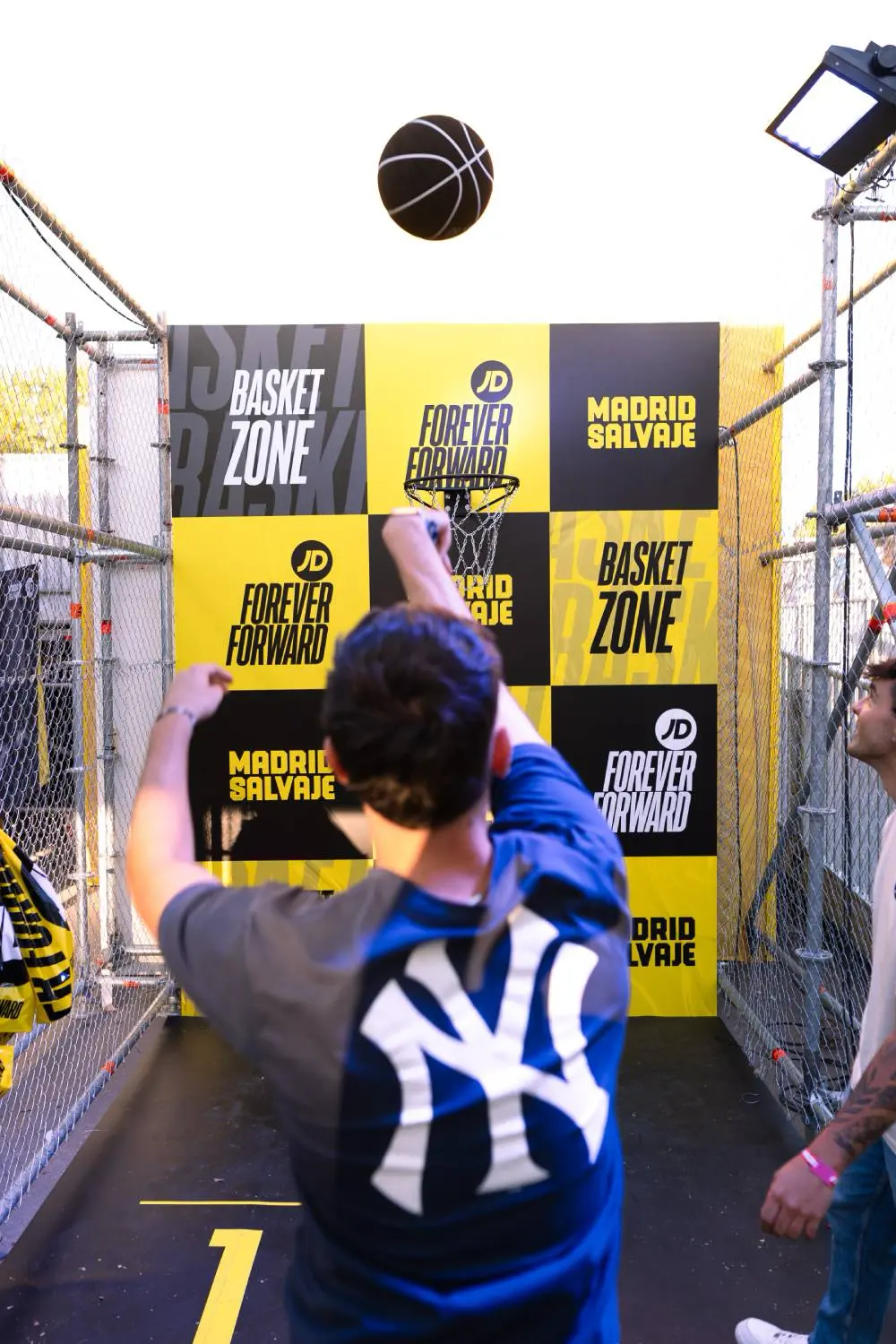
An interactive screen does not, on its own, turn the audience into the protagonist. The difference appears when an action by the audience has a perceptible effect on what is happening: it changes a scoreboard, builds an image, chooses a path or triggers a response from the stage. That reciprocity is a production decision.
If the audience does something and the event does not respond, we have added an interface; we have not yet designed participation.
The audience needs a role that fits the scene
At a match, a concert or a convention there is already a hierarchy of attention. The spectator has come to watch something. Asking them to vote, play or create only makes sense if the action expands that moment rather than forcing them to choose between the activity and the show.
The mechanic begins with a recognisable motivation. It might be to demonstrate knowledge, contribute to a collective result, get closer to a protagonist or leave a mark of their own. It is then sized: a few seconds at a busy entrance, a short pause during an interval, more time in an activation zone. The production has to make it clear when it starts, how long it lasts and when it ends.
Forrester's 2026 survey finds that two thirds of B2B event leaders are planning more workshops, roundtables and structured networking. That appetite for active formats matters, but it does not license turning every moment into a workshop. Each audience and each scene has a different capacity to absorb participation.
The full loop ends on the stage
A participation activation has four parts: a signal that reaches the audience, an action that is easy to perform, a visible response and a consequence for the experience. If a fan scans a QR and receives a private message of congratulations, there is interaction. If the sum of their decisions changes what appears on the venue screen and everyone understands it, the action takes on a collective dimension.
The response has to arrive while the person still remembers what they did. A vote whose results appear the next day loses part of its force on stage. A competition without a scoreboard people can follow does not let them feel the progress either. That is why the design of screens, sound, stage management and timing matters as much as the interface.
Physical signage deserves the same rigour. A hidden entry point, instructions that are too long or a weak connection can shut the experience down before it begins. The team should rehearse the journey from the point of view of someone who has not read the brief.
The on-stage participation loop
- SignalThe audience knows when
- GestureThey do something simple
- ResponseThe live show reacts
- EffectEveryone sees the change
GDN framework · Conceptual reading, no quantitative data
Not every action should ask for the same thing
A ten-second choice, a two-minute game and a creation that requires stopping are different commitments. The time available, people's willingness and the reward determine which one fits. Some of the audience would also rather not take part: the scene must keep working and make sense for those who only watch.
It is worth separating exposure, access, start and completion. Counting openings as participants inflates the result. Full participation is measured alongside drop-off, the time required and the response obtained. Brand recall or affinity, by contrast, call for specific instruments.
How much attention each moment can ask for
| Moment | Reasonable action | Risk if you ask for too much |
|---|---|---|
| Entry or transit | Choose or activate in seconds | Queues and loss of understanding |
| Interval | Vote or play with a visible close | Whether the mechanic survives the restart |
| Experience zone | Create, try or talk | Frustration from waiting or instructions |
| Decisive moment | Watch and live the show | Interrupting the main emotion |
Three signs the mechanic is well directed
It is understood without the team explaining it in person.
The response arrives before interest cools.
It works even if only part of the audience takes part.
The best activation also knows when to stay quiet
At a decisive point in the game, or during the performance that holds all the emotion, the phone should step back. Before that, in the breaks and on the way out, it can help the audience enter the story. The difficulty is not filling every dead moment: it is choosing one that is compatible with the rhythm of the live show and producing it flawlessly.
The first trial of a new mechanic should have a single moment, one action and one main indicator. If it works, there will be time to expand it. If it does not, we will know at which step it lost the audience.
Our view at GDN
At GDN we treat participation as an act of stage direction. We design the moment, the cue, the venue's reaction and its route into content. Technology is a tool within that script. That is how we can produce experiences in which the audience takes part without losing what it came to see.
A case that proves it
In the Forward activation with DJ Mariio, the credentials document an in-store meet-up where guests played FIFA 26 with the creator. The audience had a specific role: to join the game alongside the protagonist. It is an example of in-person participation built into an activation; the credentials do not report conversions, satisfaction or brand results.

Frequently asked questions
What is the difference between an interaction and participation?
Opening a screen is an interaction. Participating involves a decision or action with a perceptible consequence for the person, for others or for how the experience unfolds.
Do you need a dedicated app?
Not necessarily. The technical choice depends on the time available, connectivity, the type of action and the data it is legitimate to collect.
What happens if few people take part?
The action should be designed to work with partial participation. It is worth measuring entries, starts and completions to understand whether the call to take part, the access or the mechanic was at fault.
When is it better not to activate the audience?
When the main action demands full attention or the intervention would create friction. Pulling the mechanic back is part of directing a live show well.