
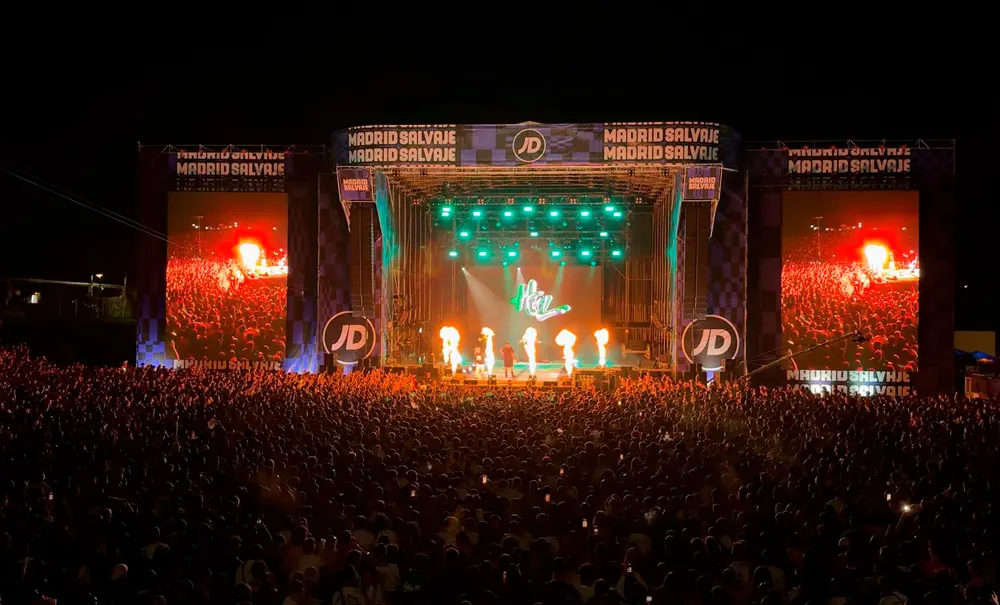
Plenty of brand activations bring in music, talent or a spectacular set. That can lift a launch, but it does not automatically turn the activation into entertainment. A format only starts to deserve the word when it has a premise, a development, a promise to the audience and enough interest for someone to choose to give it their time.
A brand can fund the show, but it cannot demand that the audience find interesting an idea that only works as an advert.
The voluntary-entry test
Before we produce anything we ask: "If the audience hadn't been sent an invitation, would they want to be here or watch this?" A competition with clear rules, a story with characters or a genuinely relevant performance can pass the test. A vast stage that simply strings product messages together probably won't.
Cannes Lions draws a distinction between branded content and entertainment-led experiences. Its criteria reward the idea, the strategy, the execution and the results; they take in live shows, content made for channels and integrated formats. The classification helps to pin down the territory, but it does not guarantee that every activation entered within it has built an audience of its own.
Entertainment lets you convey brand values without stopping the story to spell them out. The brand needs a credible reason to make it possible: access, a community, a piece of talent, a theme or a distinctive way of taking part.
A format needs rules before effects
A premise is a concrete promise: what is going to happen and why it will be worth following. Then come the rules, the protagonists, the pace, the uncertainty and the ending. Production turns that script into an experience held together by sound, visuals, direction and stage management.
A drone show can be a spectacular moment, but on its own it creates neither a series nor a repeatable format. A meet-up with a creator becomes more interesting when it offers something beyond a photo. It is worth telling the single great moment apart from an entertainment architecture that could return and evolve.
When a third-party cultural property is involved, the brand steps into a universe that already has its own rules and following. Integration demands respect for the licence, the tone and the audience. Borrowing a series' visual codes without a coherent experience produces set dressing; staging a situation that fans recognise can create a genuinely relevant extension.
The minimum structure of branded entertainment
- PremiseA reason to come in
- DevelopmentSomething changes in front of the audience
- Brand's roleIt makes the activation possible
- RepetitionIt can return with purpose
GDN framework · A conceptual reading, with no quantitative data
The sponsor has to accept a narrative role
The more a brand insists on monopolising the frame, the less room it leaves for whatever is supposed to be doing the entertaining. Its role can be to present, to enable, to reward, to reveal or to connect. What matters is that it reads clearly without forcing the action to stop so the partnership can be explained.
Working with talent and creators calls for a real editorial agreement. A community follows a person for their voice, not because they serve as a billboard. The brand needs to set boundaries and leave room for the creator to bring exactly what they were chosen for.
Measuring entertainment means looking at whether people came in of their own accord, how long they stayed with it, whether they wanted to share it and whether they came back. Consumption figures describe that behaviour; recall and perception studies help to assess what the brand was left with.
Recognising what you are really producing
| Proposition | What it offers the audience | What is worth measuring |
|---|---|---|
| Event promotion | Information or an incentive | Response to the call to action |
| Spectacular moment | A brief on-stage impact | Attention and researched recall |
| Entertainment format | A story or game people choose to follow | Voluntary consumption and return |
| Integration into an IP | An experience within a familiar universe | Fan response and fit with the tone |
Three questions before you call it entertainment
Does the premise make sense without mentioning the product?
Does the brand have a role that improves the experience?
Does the format allow for development and a voluntary audience?
A very concrete production decision
In the first briefing it is worth writing the synopsis of the experience without naming the brand. If what's left isn't an interesting proposition, we are still looking at a promotional activation. The brand is then brought back in, and we check whether its role improves the format and sits comfortably within its territory.
Not every brand needs to create entertainment. Some simply have to deliver a service or gain visibility. Refusing to dress a commercial activation up as "content" makes it no less valid; it helps you choose the right format and measure it without confusing promises.
Our view at GDN
At GDN we think of the idea as a format that will have to be produced in front of real people. That forces us to test its appeal, its rules and the brand's place in it before we build stages and content. A live show can be a great advert or it can be an experience the audience chooses; those are different briefs.
A case that shows it
Our credentials include the Mahou activation tied to the launch of the second season of El juego del calamar, with cinemas dressed for the occasion and full event coordination. It is a brand integration within a pre-existing entertainment universe. The case does not demonstrate that GDN created an original audiovisual format, nor does it evidence audience results; what it does allow is a rigorous account of producing a brand experience inside a cultural property.
Frequently asked questions
What sets branded entertainment apart from branded content?
Branded content can inform or tell a story linked to the brand. Entertainment adds a promise that someone wants to follow out of genuine interest, whether in person or on screen.
Is an opening show enough to talk about a format?
It can be a great entertainment moment. To talk about a repeatable format you need a premise, rules and the capacity to evolve beyond that single appearance.
Does the brand need to be highly visible?
Its role needs to be recognisable. Repeating the logo is no substitute for an integration that makes sense to the audience.
How do you prove that someone wanted to watch it?
Through voluntary access or consumption, how far people follow the experience and, if it recurs, whether they return. The effect on the brand calls for its own specific measurement.