
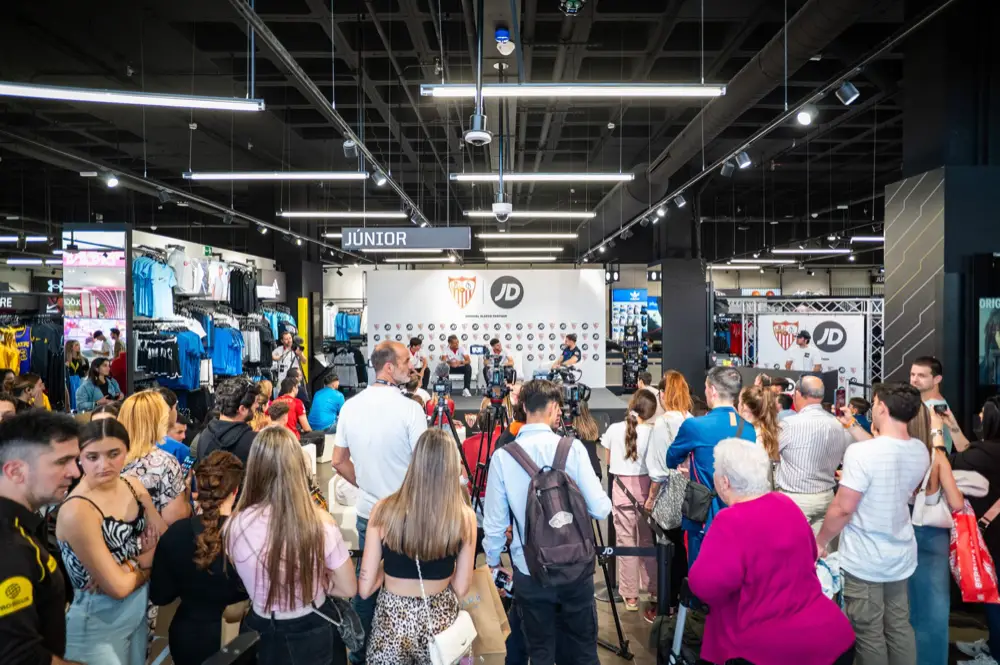
An audience hops between the venue, the broadcast, the short video and the conversations it sparks. They don't necessarily live four separate stories: they recognise the same moment across different formats. If each medium is produced on its own, the idea fragments. If a shared dramaturgy is designed, the event can be both an in-person experience and content worth following.
Unity doesn't come from repeating a logo on every screen. It comes from an idea that survives the change of viewpoint.
A single scene has several ways in
Someone in the stands shares the heat, the noise and the scale. Someone following a live broadcast needs shots, context and a clear hierarchy. Someone who lands on a twenty-second clip needs to grasp quickly what is happening and why it matters. The creative work lies in holding the same narrative tension without asking the content to mimic physical presence.
This affects the design of the space. A set can work from the entrance and vanish in the wide shot. An action can spark excitement inside the venue and prove baffling to anyone who didn't hear the instructions. Production and direction have to test the idea from every real position the audience occupies.
In its 2025 sports report, Nielsen describes how streaming distribution and new formats are widening the ways people follow sport. It doesn't mean every event should be broadcast: it means the on-screen audience can have a size and a logic quite different from the venue capacity.
The live show has an audiovisual grammar of its own
The direction should help people understand the action before it beautifies it. A legible scoreboard, named protagonists, the sound of the venue and the reaction shot can be more useful than a spectacular graphic that hides what matters.
On indoor screens, content can complete the experience in the stands: explaining rules, bringing details closer or showing a reaction that can't be seen from certain seats. For the remote viewer, you need enough transitions, pace and explanation to follow the scene without relying on the venue's host.
Social video is another reading. It can pick out an emotion or a decision and build a standalone piece. The phrase "it'll do for social" isn't enough: you need to know whether the moment will make sense with no build-up, whether the rights exist to publish it and whether the audio survives the edit.
A story designed for three ways of arriving
- VenueFeel the scale
- Live AVUnderstand the action
- Social pieceRecognise the moment
GDN framework · A conceptual reading, with no quantitative data
Fan culture doesn't follow the boundaries of the org chart
In a study on fandom, Google finds that people look for content, conversation and information on platforms such as YouTube. That activity surrounds the event before and after. A sports property or a brand can add context and occasions to take part, but it shouldn't assume it controls the whole conversation.
Working with talent or creators works when they have an editorial role and enough freedom to bring their own perspective. Inviting them to parrot the press release tends to waste the community that follows them. You have to define access, rights and objectives, and make clear which experience they are telling.
The same scene seen from different audiences
| Audience | Needs to understand | Production decision |
|---|---|---|
| Stands | What happens and when to join in | Sound, screens and stage pacing |
| Remote | Who's involved and what's at stake | Direction, graphics and context |
| Short video | Why that instant deserves attention | Shot, audio and standalone edit |
| Community afterwards | What they can comment on or share | Story and rights to circulate |
Three tests of a shared narrative
The moment makes sense from the back of the venue.
The broadcast identifies protagonists and consequences.
A short piece can circulate without inventing context.
The test of the viewer who arrives late
Before signing off a show or a piece we ask: "If someone comes in now, without having seen the previous ten minutes, do they understand what's at stake?" In the venue a screen can help; in video, a caption or a shot; on social, an edit that restores the context. If no device rescues the scene, perhaps the main narrative isn't clear enough either.
The metrics aren't identical across the different doors. Attendance describes presence, on-screen consumption describes exposure and interaction describes action. To claim they all reinforced a single brand, you need an evaluation that takes those differences into account.
Our view at GDN
At GDN we produce for the physical experience and think about how it will be seen beyond it. That demands a shared direction across staging, screens, broadcast and content. The audience present shouldn't feel they're inside a TV studio; the remote one shouldn't be watching a party nobody explained how to join.
A case that shows it
In the Movistar activation at the Copa del Rey basketball tournament, GDN's credentials record a proposal running across three seasons that included graphic campaigns, stadium assets, content, an opening show with video mapping and a drone display. It is a documented combination of a live moment and expression across other media. The credentials don't evidence audiences or how each piece was received, so we don't claim a measured cross-platform impact.
Frequently asked questions
Should every event be streamed?
No. Streaming is justified if there is a remote audience, available rights and the resources to deliver an experience that is clear and technically sound.
What changes for the set design?
It has to be checked both from the in-person audience and from the planned framings. Colour, size, lighting and placement can behave quite differently on camera.
Can a vertical clip be pulled from any broadcast?
Sometimes, yes, but it shouldn't be taken for granted. Framing, audio, captions and rights may call for a dedicated capture.
Are the venue and the content measured in the same way?
No. Attendance, views and interaction answer different questions and should be kept apart before any brand effect is interpreted.