

Booking a court is a straightforward transaction: a group, a time slot and a match. But a club has other assets that keep working for far longer than those ninety minutes: people who come back, spaces to gather in, coaches, a culture of play and a setting that can appeal to brands and creators. Turning those assets into lines of business takes far more than renting out facilities. It takes designing a programme in which playing remains the reason the place matters.
A club multiplies its value when it gives each audience a reason to come and arranges new activities without spoiling the experience of those who come to play.
Growth changes the business question
The International Padel Federation recorded more than 24,600 clubs and facilities worldwide in its 2025 report. A growing supply is one fact; the viability of each project depends on its location, investment, demand and management. The strategic question is what a club can offer that justifies the player's choice and keeps a worthwhile level of activity going between matches.
Court hire has a physical capacity and time slots with very different demand. A court tied up during a shoot can displace bookings; a high-revenue event may call for set-up, staff and a partial closure of the club. That is why adding apparent income is not enough: every new line has to weigh its costs, the hours it consumes and its effect on regular users.
The opportunity is to design a place with different ways of taking part. Someone who plays a match, someone who learns over a term, someone who brings their team together and someone who creates content are not buying the same thing. They share the space, but they need different offers, schedules and kinds of care.
The academy turns isolated visits into a relationship
A school brings continuity because it sets up a regular appointment and a visible sense of progress. It can open doors to people who do not yet have a group to play with, and give a reason to return to those who want to improve. Its offer does not end with the lesson: it needs clear levels, sustainable timetables, quality teaching and a feasible transition from instruction to free play.
For the club, that recurrence offers a more stable relationship than a one-off booking. But it also ties up capacity: blocks of courts, coaches, changing rooms and staffing in particular slots. The school will be valuable if the player feels they are improving and if the calendar keeps room for other uses. Measuring sign-ups without looking at renewals or satisfaction would tell only part of the story.
Community can begin in that repetition: recognising fellow players, arranging matches and finding reasons to cross paths. It is an outcome to be enabled, not a label earned by gathering names in a database.
Four different reasons to come to the same club
- PlayImmediate use
- LearnRecurring relationship
- GatherGroup experience
- CreateStory production
GDN framework · Conceptual reading, no quantitative data
Corporate events sell a different experience
A company might bring its team together to get to know one another better, host clients, launch a product or celebrate an achievement. A padel club offers movement, hospitality and a context for conversation quite unlike a meeting room. Each objective, however, calls for a different experience: teaching beginners is not the same as running a competition or designing a gathering with guests.
The product has to include more than courts and catering. It means defining the role of the coaches, the rules for different levels, how non-players are welcomed, the time set aside for conversation and the way the gathering carries on. If a brand takes part, its contribution should improve a moment the group will recognise.
The real cost matters too. An event budget should account for blocked-off spaces, set-up, staff, catering, technical production and any bookings displaced. That way the club can compare the income against the ordinary use it replaces, and decide which dates, times or formats make sense.
Different lines of activity don't share the same calculation
| Activity | Value and possible income | Critical condition |
|---|---|---|
| Court hire | Playing time per court | Availability and quality of service |
| Academy | Recurring learning | Teaching, progression and scheduling |
| Corporate event | An experience for a group | Production and opportunity cost |
| Shoot or creator | Use of the space or a collaboration | Permissions and coexistence with players |
| Hospitality | A stay and a relationship around the game | Useful service and real spend |
Five decisions before expanding the offer
Define which audience buys each experience and why they would return.
Calculate the court hours, staff and bookings each activity displaces.
Protect the time slots and journeys of the regular player.
Agree on access, image and rights before producing content.
Measure each line with its own indicator and avoid adding up incompatible results.
The club can be a setting for content without becoming a permanent studio
A sports venue has something a generic location cannot easily manufacture: play in progress, people with a genuine relationship to the sport and situations worth telling. That makes it attractive for photo shoots, film shoots and creators. The value, though, does not lie in an attractive backdrop alone. A good production finds the story that belongs to that place and knows who it is speaking to.
There are different models. A production can pay to use the facilities; the club can generate content for its own communication; a brand can design an experience and produce pieces out of it. Each case has different owners, deliverables, permissions and measures of success. An in-house video is not automatically a commercial activation, nor does a shoot booking create a brand partnership.
The operation protects the club's core promise. You have to mark out areas and time slots, manage technical access, obtain image consents, avoid other players appearing unintentionally and put the spaces back as they were. For a creator, those rules are part of a useful brief: they give the freedom to tell a story without intruding on anyone else's experience.
Community is built on reasons to return
A club can have plenty of visitors and little connection between them. Moving from footfall to belonging takes repeated occasions and clear roles: learning, playing, watching, taking part in a tournament, bringing someone along or returning for a gathering. Catering and lounge areas can extend the visit if the experience invites people to use them; their mere existence does not guarantee community.
Brands find value in that continuity when they contribute something relevant: access, training, play, a gathering or content. A community is not a captive audience to be shown logos. If an activation interrupts the match or pushes aside the people who use the club, it burns through the very trust that made the place interesting.
Evaluation must also tell the products apart. A booking measures use; a course renewal, continuity; a corporate enquiry, commercial interest; a viewed piece, distribution. To know whether the bond is growing, you have to study voluntary returns, the relationships that form and the audience's perception, each with a suitable method. A single indicator does not explain the whole model.
Designing the calendar is designing the business model
The key is to assign a priority to each use before selling it. Which slots the regular player needs, which the academy can occupy, which spaces can be set aside for an event, and where a film crew can work without getting in the way of play. That architecture determines how many activities genuinely fit and what the club should turn down.
Then comes the commercial offer. The company buys an experience that brings people together; the creator, production conditions; the student, learning; the player, a reliable court and setting. Each offer needs its own booking terms, staffing and price. The club gains flexibility when it knows the cost of each format and can protect its character as it chooses projects.
The final question is not how many activities fit on the website. It is which of them improve the place for the people who use it, which bring in enough income once their costs are covered, and which generate a story the club will want to keep telling.
Our view at GDN
At GDN we believe a sports venue should be thought of as a living experience. An idea for a brand or an event only works when it understands the people, the schedules and the codes that already make the place valuable. We design what will happen, we make it possible through production and we prepare its story so the gathering has a life beyond the day.
A case that proves it
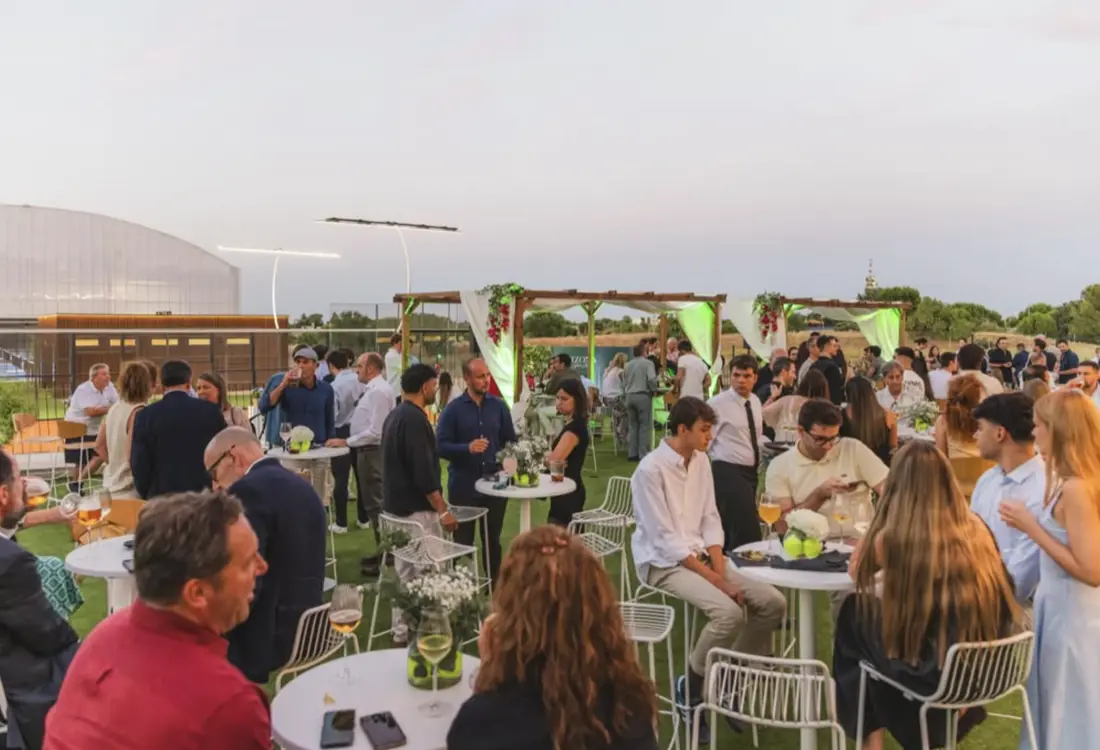
The opening of Tizona Sport Club shows this way of working at a specific moment. GDN organised the launch of the Pozuelo club: production and guest management, the opening ceremony, audiovisuals, catering, merchandising and content. According to our write-up of the event, we prepared stands and terraces with capacity for more than 150 guests, spaces for photographs, a reception, live music and communication activities. It was the opening staging of a place conceived for living padel off the court as well.
Frequently asked questions
Does every club need to offer corporate events?
No. It makes sense when there is demand, the spaces, the production capacity and a format that fits the venue's usual experience.
Does an academy create community automatically?
It brings repetition and occasions to meet. Community appears when people find real reasons, and real ease, to connect and return.
Is it worth hiring out courts for a shoot?
It depends on the fee, the resources required, the bookings displaced and the effect on other users. You have to compare the income against the full cost.
What should a brand plan for before activating in a club?
The benefit to players and guests, the timing, the staff, the image permissions and coexistence with the club's ordinary running.
How do you measure whether the model works?
Line by line: use and occupancy, training continuity, event margin, content results and voluntary returns. Each figure answers a different question.