
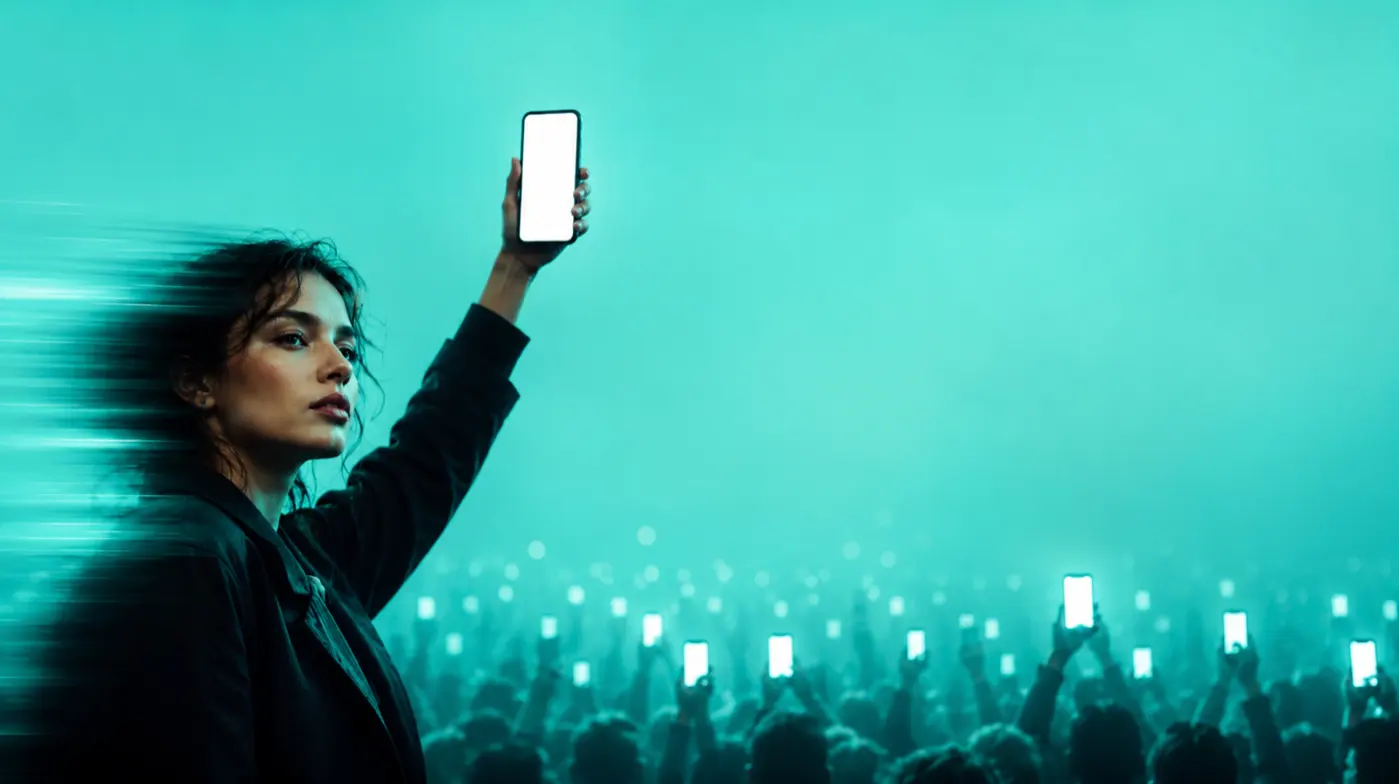
Before budgeting for wristbands, handsets or an app, it is worth looking at the device the audience already carries. The phone can serve as the way into a vote, a game controller, a coordinated source of light or a place to keep a result. But that availability does not oblige you to use it: the experience only improves if the gesture fits the moment and produces a response worth the attention it asks for.
The phone works better as a brief controller for a shared experience than as a screen onto which we move the whole event.
The hidden cost of handing out technology
A device given out at the door demands inventory, staff, charging, instructions, collection and a plan for whoever arrives late or does not know how to use it. A phone avoids many of those tasks, though it introduces others: different sizes, battery life, accessibility and variable connectivity. The decision is not "hardware versus software". It is which form of access removes the most friction for the specific action.
A web experience can open from a QR code without requiring a prior installation. MDN notes that a progressive web app can work like an ordinary website even when the browser does not offer to install it. That possibility is especially relevant when the activity lasts a minute and the audience has only just discovered it.
Forrester observes in 2026 a greater demand for participation at B2B events. Participation is not won by putting up a QR code: you design a reason to take part, an action that can be understood and an effect that appears before the moment is over.
The venue needs a choreography of attention
There are four questions that come before the interface. What is the audience looking at? How long can they look away? What will they do with the phone? Where will they see the result? If the reward appears only on their screen, the activity can be individual. If the gesture changes a venue screen or builds a collective reaction, it enters the dramaturgy of the live show.
A vote during a pause allows for a very brief instruction and a visible close. A game of several minutes calls for a different space and rhythm. A choreography of light may ask for a single synchronised action. Demanding the same register and the same duration from all these mechanics would be a design mistake.
The phone must not compete with the play or the main performance. When the show returns, the mobile experience should end, drop into a passive state or wait for the next moment.
The minimum sequence of a live mobile activation
- MomentAttention is available
- AccessA frictionless way in
- GestureA single understandable action
- ResponseThe live show reacts
GDN framework · Conceptual reading, no quantitative data
Access matters as much as the idea
A useful test begins far from the production computer. Can the signage be made out from the attendee's actual position? Does the experience open on a congested network? Can it be understood without audio, with legible text and without complex gestures? Is there a path for those who have no phone or would rather not use one?
It is worth cutting the steps between curiosity and first result. Asking for an account, several permissions and a form before showing any value turns a brief moment of participation into a negotiation over data. If a later purpose requires identification, it must be handled transparently and at the right moment.
The test must include partial operation. Not everyone will take part, and that must not ruin the scene: a collective effect has to make sense with only part of the stands active.
Choosing technology for the action, not the trend
| Situation | Possible solution | Decisive check |
|---|---|---|
| A one-minute vote | A lightweight web page from a QR code | Result visible before the reset |
| An extended game | An environment with persistent progress | A real reason to come back |
| A collective effect | Phone plus venue screen | Works with partial participation |
| The central moment of the show | No mobile involvement | Attention stays on the scene |
Three tests before opening the doors
Full access from a real position in the stands.
A rehearsal with limited connectivity and different devices.
An understandable alternative for those who do not take part.
Choose a moment before choosing a platform
A sensible first pilot occupies a single instant: a pre-show, a wait or a break. Define the gesture, the maximum time, the venue's response and one main metric. If it works, you can repeat and expand it. If not, you look at where the journey broke down: signage, opening, comprehension, participation or response.
The right technology will be the one that delivers that script reliably. Sometimes it will be a lightweight web page; other times a specialised device, or no screen at all. The production constraint is part of the idea.
Our view at GDN
At GDN we start with the live moment and the role we want to give the audience. We design the signal in the space, the action on the phone and its response on stage as a single production. The phone is a powerful tool when it helps the audience become part of what is happening; knowing when to put it away is a judgement too.
Frequently asked questions
Do you need to build an app to activate the audience?
Not by default. A brief experience can be handled on the web. An app makes sense if there are persistent features, an ongoing relationship and reasons to install it.
What happens if the venue's network fails?
The design should be tested with limited connectivity, keep loads to a minimum and provide for a fallback behaviour. It is unwise to promise synchrony or continuous video without real rehearsals.
Does everyone have to use their phone?
No. The scene has to work with partial participation and offer a complete experience to those who are only watching too.
When can you ask for a piece of personal data?
When there is a clear purpose and appropriate handling. Access to a brief action should not become an unnecessary form.