
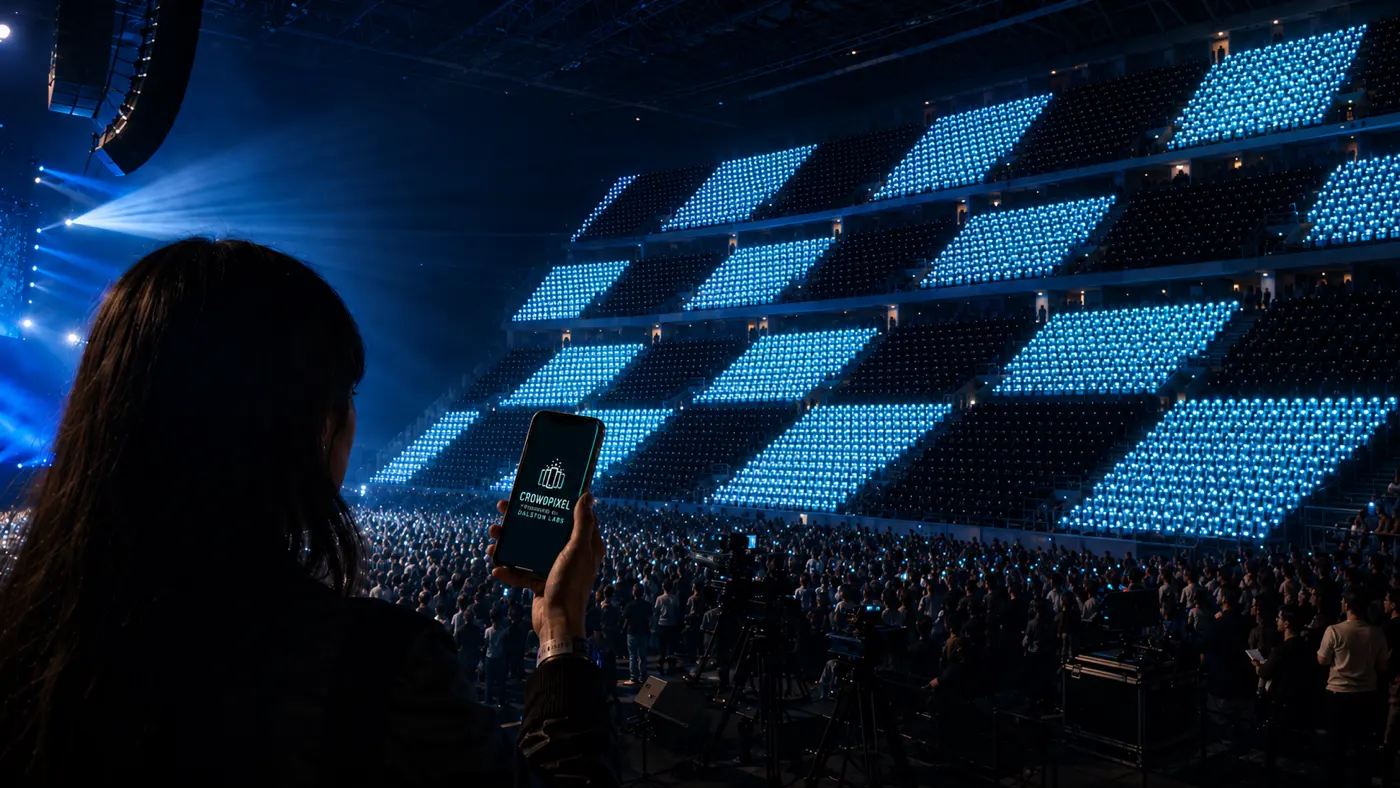
An LED screen on a stand and a QR code next to it do not create a connected experience. They remain two separate elements until what one person does on one surface produces an understandable response on the other. The real difficulty of phygital is not placing technology in the space: it is directing the transition between private gesture, public reaction and real-time story.
The experience becomes connected when the action on the phone has visible consequences in the space, and the space gives a clear reason to act again.
Three surfaces with different jobs
The physical space brings people together and gives scale. The phone allows a personal decision, in their own language and at their own pace. The screen or the staging system returns a shared signal. A connected mechanic distributes those roles clearly: a person does not have to stare at their phone throughout the whole show, and the screen does not display data that only matters to those who voted.
A prediction on the phone can build a collective visualisation; a choice at the stand can change the piece that appears on a screen; a group action can alter a scoreboard. In each case you have to explain where the change came from, so that the audience attributes the consequence to their own gesture and not to a pre-programmed video.
For sport, PwC describes a move towards more integrated digital and in-person experiences. That trend does not turn any set-up into phygital: what matters is how the actions relate to one another, not the number of devices.
Synchronisation is a production decision
You have to decide when the audience can take part, how long a vote stays open and at what point the stage management reveals the result. If the signal arrives late, cause and effect come apart. If it arrives too soon, those still coming in are left out. The tempo of the live show has to be part of the technical specification.
A high-capacity experience needs to behave in an understandable way with partial participation and with intermittent connections. The screen needs a waiting state, a response to error and a staged ending. The host and the operator must know those states and be able to carry on if the digital mechanic stops.
In 2026 Forrester finds more integration between event platforms and marketing systems, alongside a demand for participation. Integrating data can make later continuity easier; it does not fix a poorly designed staged response.
The chain that turns a digital action into a physical moment
- SpaceInvites and gives context
- PhoneCaptures a decision
- LiveShows the consequence
- ContentTells what happened
GDN framework · Conceptual reading, no quantitative data
A single story at different sizes
The phone has to explain the task in a few words. The screen has to make the consequence visible from a distance. The content that follows has to show cause and result for those who were not there. This calls for coordinating interface design, signage, screen graphics, sound and camera.
The common mistake is to design each surface with a different team and bring them together at the end. You end up with a correct website, an attractive screen and a staging that tells no story, because they share neither language, nor states, nor timings.
Accessibility demands more than one route. Someone who does not use their phone must still be able to follow the show. The digital gesture needs legible instructions, alternatives where appropriate and a public response that does not depend on everyone taking part.
The role of each layer in a connected experience
| Layer | Main function | Essential test |
|---|---|---|
| Signage and space | Invite without interrupting | It is understood from the real position |
| Mobile interface | Allow a brief action | It works on a limited network |
| Screen and stage management | Respond at the right moment | Cause and effect are legible |
| Live direction | Take it beyond the venue | It captures gesture and consequence |
Three failures that show up in a full rehearsal
The screen changes without anyone understanding why.
The interface keeps asking for actions when the show has already moved on.
The result only works if the whole venue takes part.
Test the whole chain, not each piece in isolation
A useful rehearsal travels the path from the physical signal to the audiovisual output. You test a real entry point, an action, its arrival in the system, the stage management decision, the result on screen and the shot that explains it. Then you repeat it with fewer participants, a poor network and a delay in the running order.
You measure both the individual interaction and the quality of the collective moment. A system can register thousands of votes and produce an outcome that nobody understood. That difference only shows up when technology and live direction review the experience together.
Our view at GDN
At GDN, phygital begins in the script of the live show. We design how a personal action turns into a shared response, and we produce the rhythm, the screens and the content so that it is understood. Technology has to work in the service of the event, including when it fails or when part of the audience decides not to use it.
Frequently asked questions
Are a screen and a QR code enough to call an experience phygital?
No. There must be a perceptible relationship between what the audience does on one surface and what changes on the other.
Do you need a dedicated app?
Not necessarily. A mobile website can resolve the action; the choice depends on the duration, the complexity and the continuity needs.
What happens if the whole audience does not take part?
The scene has to remain legible and engaging. Partial participation is accounted for from the design stage, not treated as a fault.
How do you rehearse a connected activation?
From the physical entry point through to the result on screen and its audiovisual capture, including programme delays and limited connectivity.